
Executive Stress Relief: Science-Backed Recovery Protocols
Strategic recovery for those who carry organizational weight
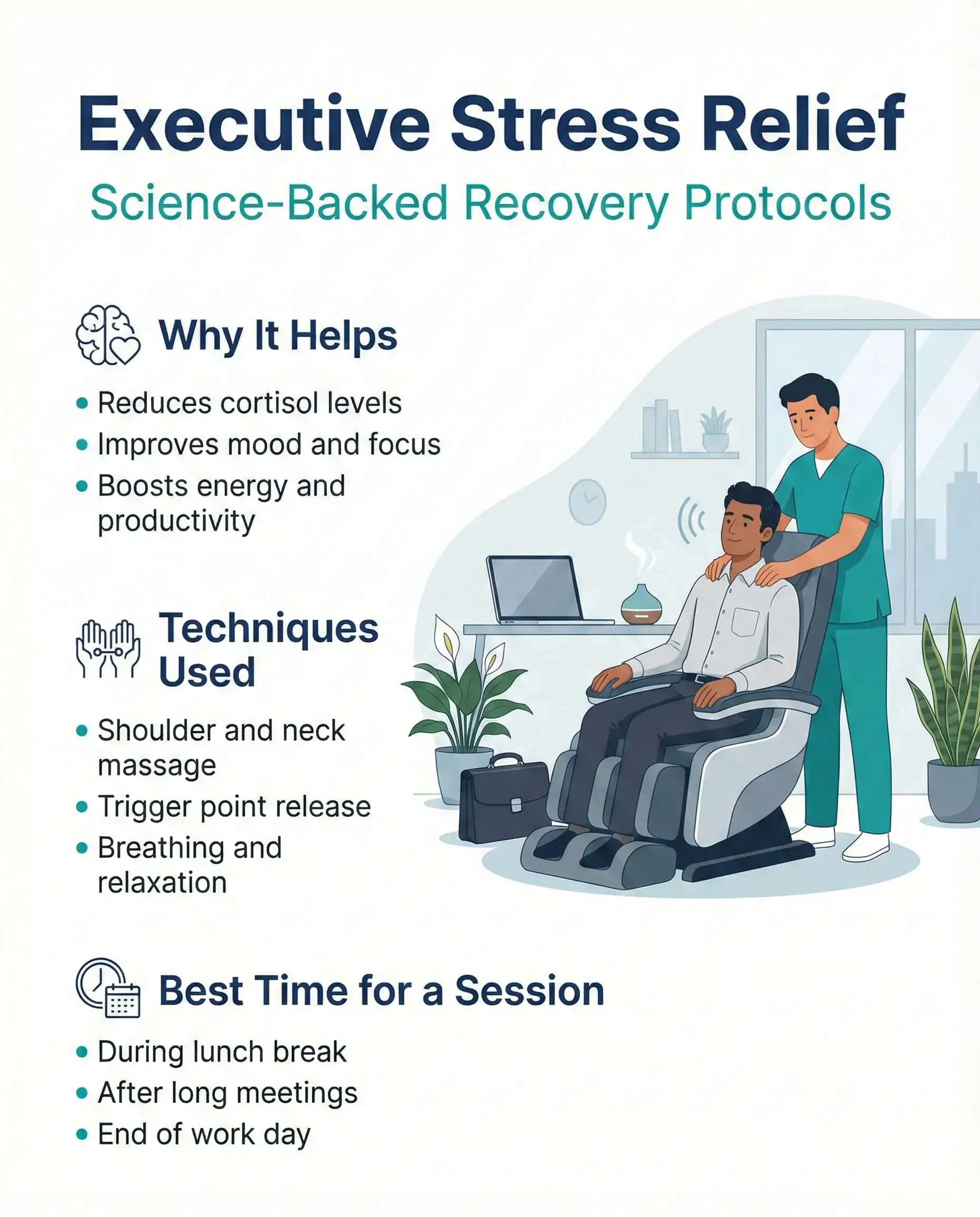
The quarterly results call ended an hour ago, but your mind is still running scenarios. Your shoulders haven't dropped from your ears since the board presentation last week. Sleep comes in fragments—three hours here, four there—interrupted by thoughts about the restructuring, the compliance issue, the key hire who might be leaving. This isn't occasional stress. This is the sustained cognitive load that comes with responsibility for outcomes that affect hundreds of people.
Executive stress operates differently from general workplace stress. The decisions are more consequential. The responsibility is heavier. The cognitive demands are relentless. Standard stress advice—take a vacation, practice mindfulness, exercise more—often fails because it doesn't account for the unique neurological and physiological patterns that leadership roles create. What executives need is a recovery protocol as sophisticated as the demands they face.
Executive Stress: The Hidden Performance Cost
Before exploring solutions, it's worth understanding exactly what executive stress does to performance. The research here is sobering—and clarifying. Chronic stress doesn't just feel unpleasant. It measurably degrades the cognitive functions most critical to executive effectiveness.
Decision Fatigue and Cognitive Load
Executives make hundreds of decisions daily—many with incomplete information and significant consequences. Each decision depletes the same cognitive resources. Research from the National Academy of Sciences shows that decision quality deteriorates predictably as these resources deplete. Judges grant parole at 65% in morning sessions but drop to nearly 0% by late afternoon—same cases, same judges, depleted capacity.
In corporate settings, this translates to poorer strategic choices later in the day, increased risk-aversion (or inappropriate risk-taking), and reduced ability to synthesize complex information. The executive who makes excellent decisions at 9 AM may make mediocre ones by 4 PM—not from lack of ability, but from accumulated cognitive depletion.
The Physiology of Chronic Stress
Sustained stress keeps cortisol chronically elevated. This stress hormone is useful in short bursts—it mobilizes energy and sharpens focus for immediate threats. But chronic elevation produces cascading damage: impaired memory consolidation, reduced prefrontal cortex function (the brain region responsible for strategic thinking), disrupted sleep architecture, and weakened immune response.
Studies in the Journal of Neuroscience demonstrate that chronic stress actually shrinks the hippocampus (memory center) while enlarging the amygdala (fear and stress center). This structural change biases the brain toward threat detection and away from creative problem-solving—exactly the opposite of what executive performance requires.
Impact on Leadership Effectiveness
Stressed leaders make worse decisions, but the impact extends beyond personal performance. Research in organizational psychology shows that executive stress is contagious—it propagates through teams via emotional contagion, affecting morale, creativity, and retention. The leader's stress response becomes the organization's stress response.
Furthermore, chronic stress impairs emotional regulation, making leaders more reactive and less able to maintain the composed presence that teams need during uncertainty. The very moments that demand the steadiest leadership are those when stress most compromises it.
| Dimension | General Work Stress | Executive Stress |
|---|---|---|
| Decision scope | Task-level, reversible | Strategic, often irreversible |
| Responsibility | Individual outcomes | Organizational outcomes, livelihoods |
| Visibility | Limited scrutiny | Constant scrutiny from multiple stakeholders |
| Recovery time | Evenings/weekends often protected | Always accessible, boundaries blur |
| Cognitive load | Focused tasks | Multiple complex situations simultaneously |
| Consequence of error | Personal impact | Cascading organizational impact |
How Executive Stress Manifests Physically
Stress doesn't stay in your mind—it accumulates in your body. Understanding where you carry executive stress helps target recovery interventions effectively.
Tension Patterns in High-Pressure Roles
Executives develop characteristic tension patterns. The trapezius muscles (between neck and shoulders) contract during sustained mental effort and rarely fully release. The jaw clenches during difficult conversations and decision-making—often leading to tension headaches. The upper back rounds forward from screen work and the postural collapse that accompanies cognitive fatigue, similar to desk worker patterns. These patterns become chronic, creating feedback loops where physical tension maintains mental stress.
- ✓Chronic neck and shoulder tension (trapezius, levator scapulae)
- ✓Jaw tension and teeth grinding (masseter, temporalis)
- ✓Upper back tightness and forward head posture
- ✓Lower back compression from prolonged sitting
- ✓Tension headaches originating from cervical strain
- ✓Shallow breathing patterns restricting thoracic mobility
Sleep Disruption from Decision Load
The executive mind doesn't quiet easily. Unresolved decisions, upcoming challenges, and organizational concerns activate the brain's default mode network—the same network responsible for rumination. This activity suppresses melatonin production and fragments sleep architecture, reducing the deep sleep stages essential for cognitive restoration. Understanding sleep protocols becomes critical for sustained performance.
Studies of senior executives reveal that most average 5-6 hours of sleep despite needing 7-8 for optimal cognitive function. This chronic deficit compounds: each night of insufficient sleep further impairs the executive functions needed to manage stress effectively, creating a deteriorating cycle.
Immune System Suppression
Cortisol suppresses inflammatory response—useful for short-term stress, problematic when sustained. Executives often report getting sick immediately when they finally take vacation: the sudden cortisol drop reveals the accumulated immune debt. Regular illnesses, slow wound healing, and persistent low-grade inflammation are all markers of stress-compromised immunity.
The Research Behind Recovery
The case for massage therapy in executive stress management rests on substantial evidence. Multiple mechanisms work together to counteract the specific patterns of executive stress:
Cortisol Reduction Through Massage
A comprehensive meta-analysis published in the International Journal of Neuroscience examined studies measuring cortisol before and after massage therapy. The findings: massage reduces cortisol by an average of 31%—a significant shift in stress chemistry. This reduction begins during the session and continues afterward, with cumulative effects from regular sessions.
For executives operating with chronically elevated cortisol, this represents a meaningful intervention. Unlike stress management techniques that require sustained effort and attention (resources already depleted), massage produces physiological changes passively. You receive the benefit without expending additional cognitive resources.
Parasympathetic Nervous System Activation
Your autonomic nervous system has two branches: sympathetic (fight-or-flight) and parasympathetic (rest-and-digest). Executive stress maintains sympathetic dominance—the body remains primed for threat response even when physical danger is absent. Massage activates the parasympathetic branch, triggering what Harvard researcher Herbert Benson termed the 'relaxation response.'
This shift produces measurable changes: heart rate slows, blood pressure drops, breathing deepens, digestion resumes, and muscle tension releases. More importantly, the prefrontal cortex—suppressed during stress response—comes back online, restoring access to strategic thinking capabilities.
Cognitive Performance Improvement
Research from the University of Miami's Touch Research Institute demonstrates that massage increases both serotonin (28%) and dopamine (31%). These neurotransmitters are fundamental to cognitive performance: serotonin regulates mood, sleep, and anxiety; dopamine drives motivation, focus, and reward processing. The post-massage increase in these neurotransmitters often manifests as improved clarity and mental energy.
Many executives report that their best strategic thinking occurs not during intense work sessions, but during or after recovery periods. This isn't coincidence—it reflects the cognitive restoration that occurs when stress response subsides and the brain can access its full capacity.
Decision Quality and Stress Connection
The connection between stress and decision quality is well-documented. Research in cognitive psychology shows that stress biases decisions toward familiar patterns and away from novel solutions, increases loss aversion beyond rational levels, and reduces ability to hold multiple variables in working memory. Strategic recovery directly counteracts these effects.
Strategic Recovery Framework
Effective executive stress management isn't reactive—it's strategic. Building sustainable wellness habits requires a framework that structures recovery around the demands of high-pressure roles:
Pre-Decision Intensive Recovery
Major decisions—M&A evaluation, strategic pivots, key hires—require peak cognitive function. Schedule intensive recovery (90-minute massage session) 24-48 hours before critical decisions. This timing allows physiological benefits to fully manifest while ensuring you arrive at the decision point with restored cognitive resources.
This isn't superstition—it's applied neuroscience. The executive who prepares physically for cognitive demands performs measurably better than one who attempts to think through exhaustion.
Post-Decision Reset Protocols
Major decisions—regardless of outcome—deplete cognitive resources and often elevate stress hormones. The uncertainty period between decision and result is particularly taxing. Schedule recovery sessions within 48 hours of significant decisions to prevent stress accumulation and restore capacity for the next challenge.
Travel Recovery Routines
Business travel compounds executive stress: jet lag disrupts circadian rhythms, unfamiliar environments prevent deep rest, and travel itself is physically taxing. For executives managing operations across Mumbai, Bangalore, Delhi, and Chennai—or international travel to US and European markets—travel recovery is essential.
Schedule home massage within 24 hours of returning from significant travel. The combination of physical recovery (addressing travel-related muscle tension) and nervous system reset (countering jet lag effects) accelerates return to baseline function. For frequent travelers, this becomes a non-negotiable protocol.
Quarterly Deep Recovery Sessions
Beyond weekly maintenance, schedule quarterly intensive recovery periods: 2-3 massage sessions within a week, ideally combined with reduced meeting load. These periods address accumulated stress debt that weekly sessions may not fully resolve. Align with natural business cycles—post-quarter-end, after major initiatives close.
| Timing | Session Type | Purpose |
|---|---|---|
| Weekly maintenance | 60-90 min massage | Prevent stress accumulation, maintain baseline |
| Pre-major decision | 90 min deep session | Optimize cognitive function for critical choices |
| Post-major decision | 60-90 min recovery | Reset after cognitive depletion |
| Post-travel (24 hrs) | 60-90 min session | Counter jet lag, restore circadian rhythm |
| Quarterly intensive | 2-3 sessions/week | Address accumulated stress debt |
Integrating Massage into Leadership Routine
The challenge for most executives isn't understanding the benefits—it's implementation. Here's how successful leaders make recovery sustainable:
Weekly vs Bi-Weekly Protocols
For executives in high-pressure roles—particularly during demanding periods—weekly massage delivers optimal results. The benefits compound: each session builds on the previous, gradually resetting baseline stress levels. Bi-weekly sessions maintain benefits but may not address rapid stress accumulation during intense periods.
A practical approach: weekly sessions during demanding quarters, bi-weekly during steadier periods. The investment scales with the demand on your performance.
Timing Around High-Pressure Periods
Strategic timing amplifies benefits. Consider your typical week: when does stress accumulate? When do you need peak performance? Common patterns for Indian executives:
- Sunday evening: Reset before the week, arrive Monday with full cognitive capacity
- Wednesday evening: Mid-week recovery to sustain performance through Friday
- Post-board meetings: Recovery after high-visibility presentations
- Before quarterly closes: Optimize for high-stakes periods
- After town halls or major announcements: Reset after high-demand events
Combining with Other Recovery Methods
Massage works synergistically with other recovery practices. It complements rather than replaces exercise (which also reduces cortisol), meditation (which trains attention regulation), and quality sleep (which consolidates cognitive gains). The advantage of massage: it requires no effort from you. For executives with depleted cognitive resources, this passive recovery is particularly valuable.
Privacy and Discretion: The Home Service Advantage
For executives, the where of recovery matters as much as the what. Premium home wellness addresses practical concerns that spa visits cannot:
Complete Privacy
At a spa, you might encounter colleagues, board members, clients, or competitors. For high-profile executives, this visibility can be unwelcome. Your wellness practices remain private in your home. No encounters at reception, no small talk in waiting rooms, no risk of being seen when you'd rather not be.
Zero Workplace Disruption
Leaving the office for a spa appointment signals absence to your team. Home massage, scheduled before or after work hours, creates no such visibility. Your recovery practice remains separate from professional perception—important for leaders who manage how they're perceived.
Schedule Flexibility
Executive schedules don't conform to spa hours. Home massage adapts to your availability: 6 AM before the day begins, 10 PM after evening calls with international teams, Sunday evening to reset for the week. The service works around you, not the reverse.
Immediate Transition to Rest
After a spa massage, you re-enter the world: checkout, traffic, the stimulation of public spaces. Benefits begin dissipating immediately. At home, when the session ends, you're already in your private space. Continue resting, have dinner, sleep. The relaxation compounds rather than evaporating during the drive home.
Massage Types for Executive Stress
Different massage modalities address different aspects of executive stress. Selection depends on your current state and priorities:
| Type | Primary Benefit | Best When |
|---|---|---|
| Swedish Massage | Parasympathetic activation, general relaxation | Nervous system reset is primary goal |
| Deep Tissue | Release chronic tension patterns | Physical tension has accumulated significantly |
| Aromatherapy | Enhanced relaxation, mood support | Sleep improvement is priority, high anxiety |
| Hot Stone | Deep muscle relaxation, warmth | Particularly tense, during cooler months |
| Sports Massage | Recovery from physical activity | Active executive maintaining fitness routine |
Many executives rotate based on current needs: deeper work when physical tension accumulates, Swedish for nervous system reset, aromatherapy when sleep improvement is the priority. For active executives, post-workout recovery techniques may be appropriate. Communicate your current state to your therapist—they'll adjust technique accordingly.
The ROI Perspective
Executives evaluate investments by return. Our annual wellness investment guide provides detailed analysis. Here's how to frame recovery investment:
Productivity Gains
Sleep deprivation and chronic stress produce cognitive impairment comparable to alcohol intoxication. An executive operating on 5 hours of sleep with elevated cortisol is not performing at capacity—regardless of how it feels subjectively. If regular massage improves sleep and reduces stress, the productivity gains likely exceed the time and money invested.
Decision Quality
One better strategic decision can justify years of recovery investment. If massage-supported cognitive restoration prevents one significant error or enables one valuable insight, the ROI is positive. Given the stakes of executive decisions, this calculation strongly favors investment in recovery.
Longevity of Performance
Burnout ends careers. Health crises interrupt them. The executives who sustain peak performance over decades are those who manage their resources—including physical and mental reserves. Regular recovery isn't an expense against current performance; it's an investment in continued ability to perform.
Frequently Asked Questions
How often should executives get massage for stress management?
Is massage effective if I can't fully relax during the session?
What if I only have time for 60-minute sessions?
Can massage help with decision fatigue specifically?
How does massage compare to other stress management approaches?
Should I schedule massage before or after important meetings?
What should I tell my massage therapist about executive stress?
How long until I notice benefits from regular massage?
Strategic Recovery as Competitive Advantage
The executives who sustain excellence over decades understand something that those who burn out miss: performance is a function of both effort and recovery. Working harder without recovering harder leads to diminishing returns, then declining returns, then breakdown. Strategic recovery isn't a luxury—it's a performance multiplier. Explore our complete executive wellness guide for comprehensive strategies.
Home massage removes the friction that prevents busy executives from prioritizing recovery. No travel time. Scheduling that adapts to you. Complete privacy. Immediate transition to rest. It's recovery designed for how demanding careers actually work—not how wellness programs imagine they should work. For couples, shared recovery practices multiply the benefits.
The research is clear: massage produces meaningful physiological changes that directly counteract executive stress patterns. The economics favor the investment. The only question is whether you'll treat recovery as optional or as the strategic necessity it is. High performers increasingly choose the latter.
Related Articles
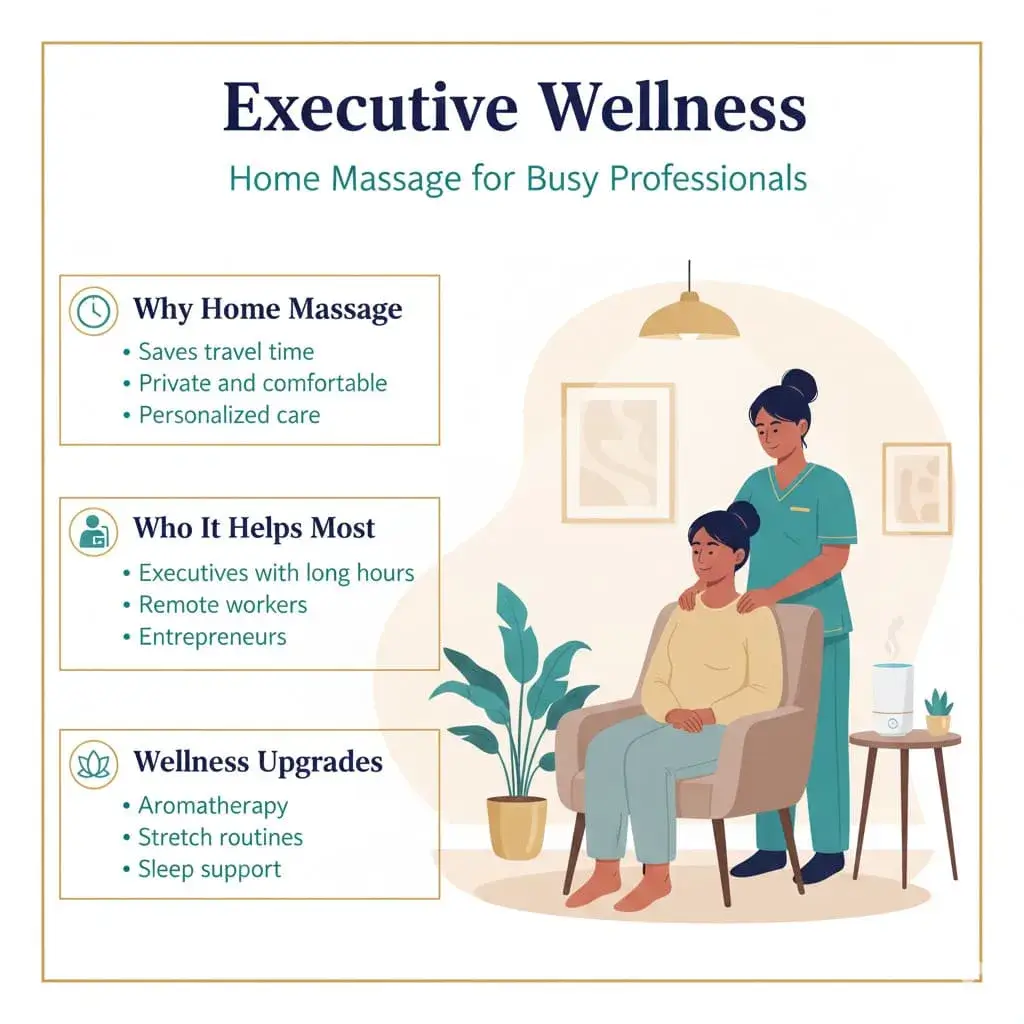
Executive Wellness: Home Massage for Busy Professionals
How successful professionals use home massage to manage stress and maintain peak performance. Strategic wellness protocols for demanding careers.
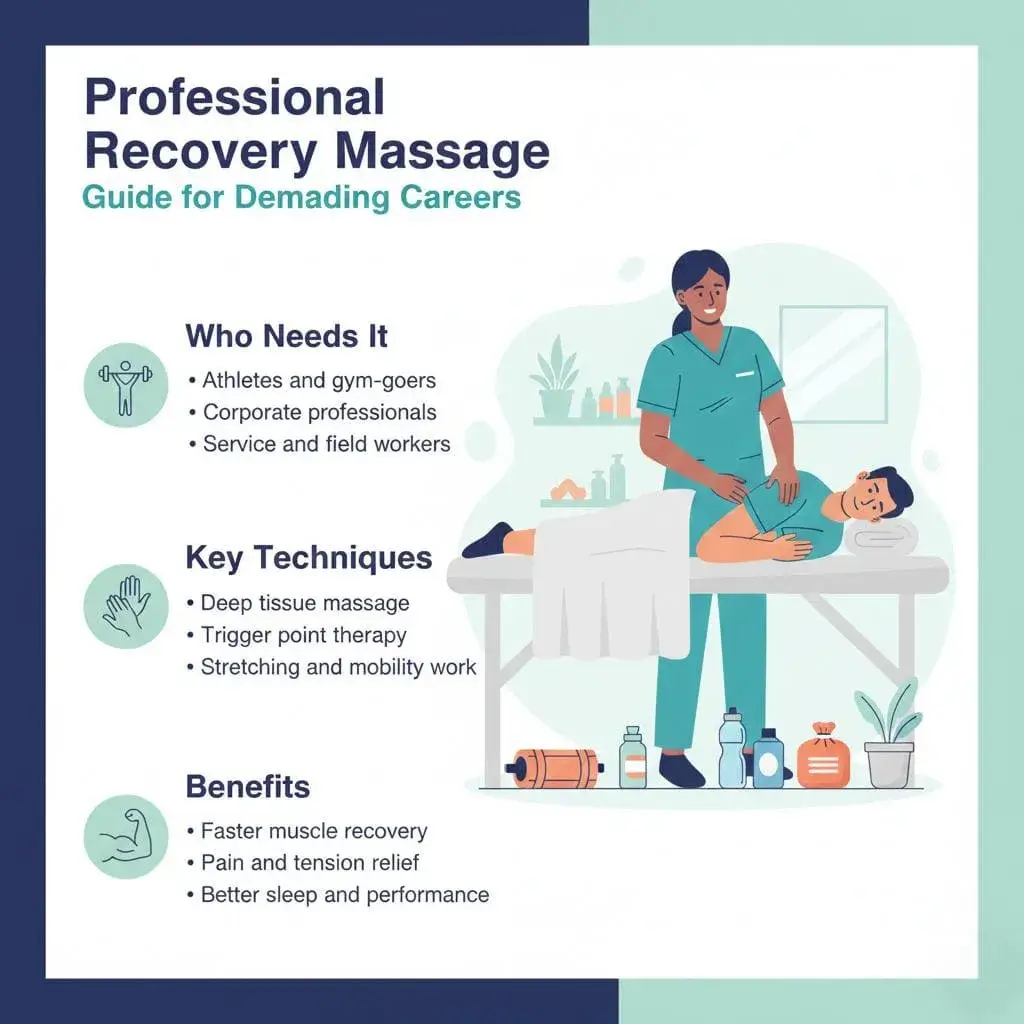
Professional Recovery Massage: Guide for Demanding Careers
How professionals in demanding careers use strategic recovery massage to maintain peak performance. Protocols for physical, cognitive, and travel recovery.
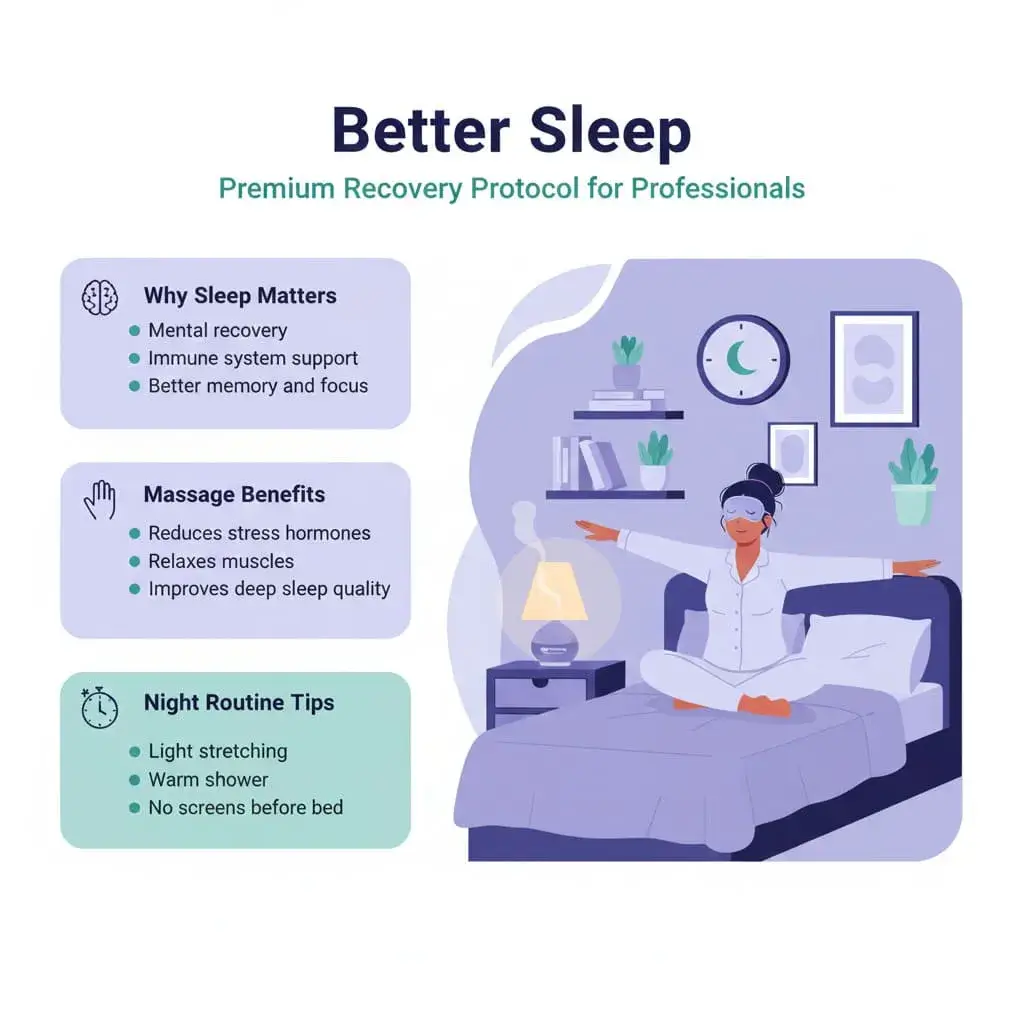
Better Sleep: Premium Recovery Protocol
How high-performers use strategic massage protocols to optimize sleep quality. Evidence-based sleep recovery approaches for cognitive performance.
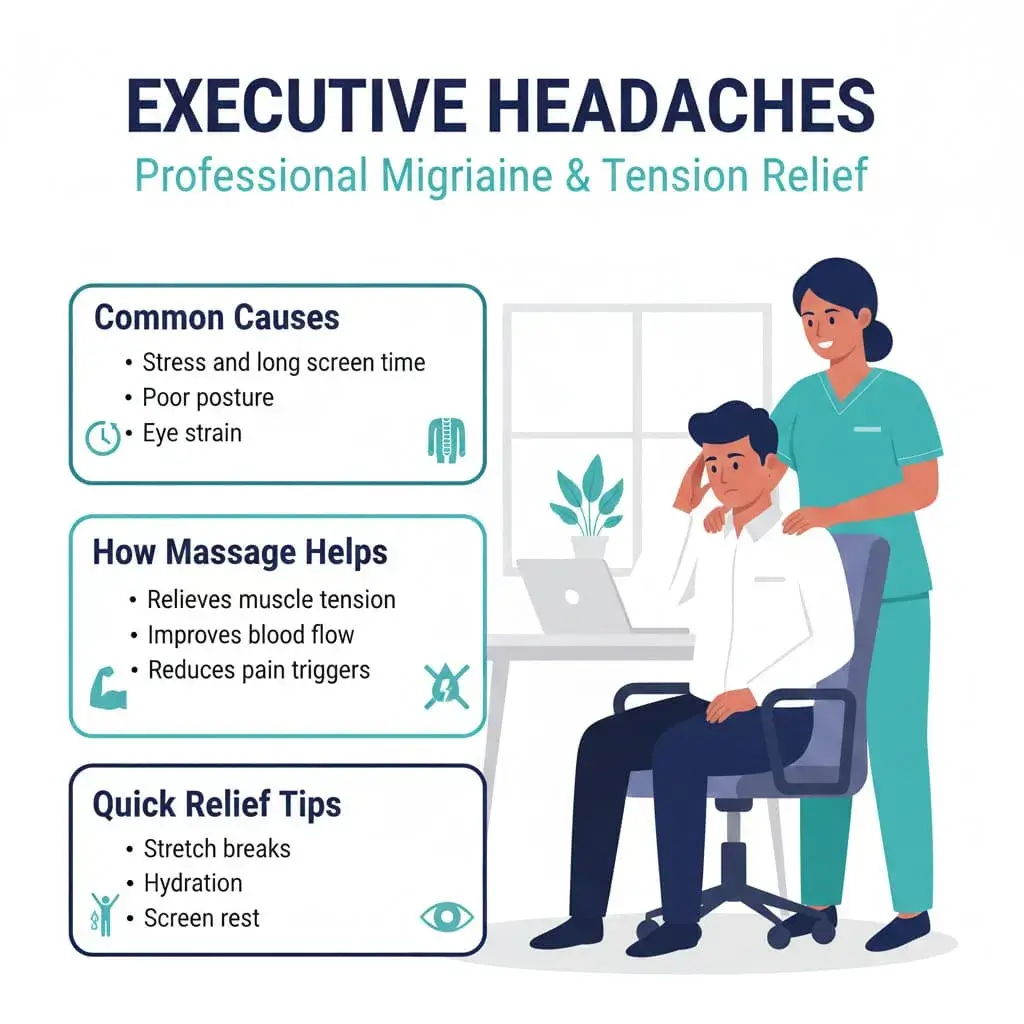
Executive Headaches: Professional Migraine & Tension Relief
How professionals use massage therapy to prevent and relieve tension headaches and migraines. Evidence-based headache management for demanding careers.

Sustainable Wellness: Building Habits That Last
How busy professionals build wellness routines that actually stick. Evidence-based strategies for making self-care sustainable rather than sporadic.